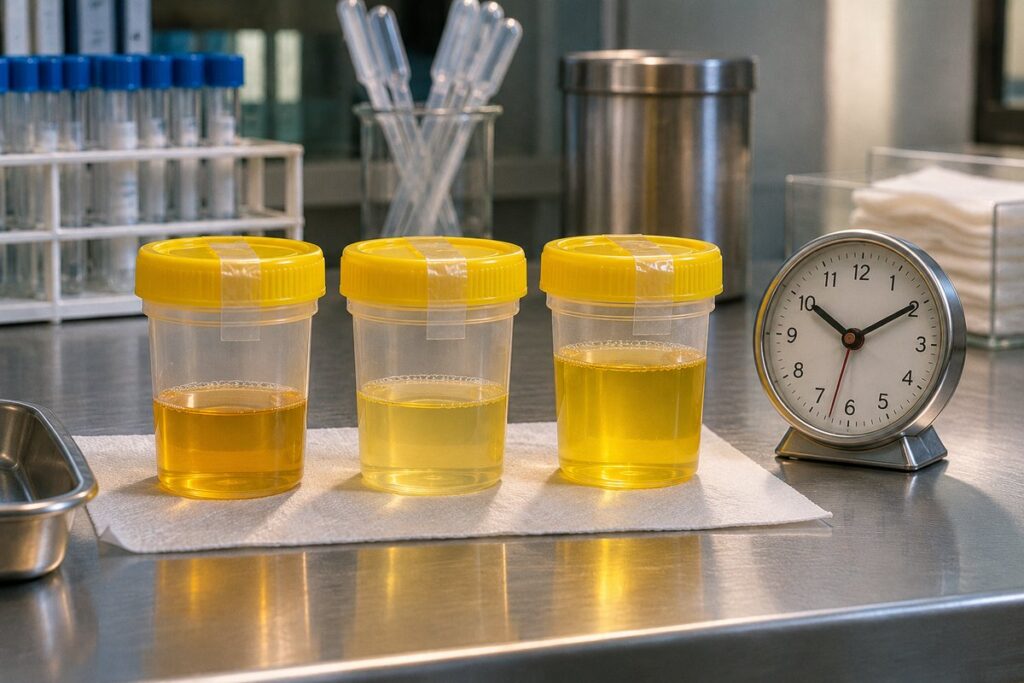
Imagine numbering the collection cups from a single laboratory visit and then taking away the labels that give the times. An analyst can still say which specimen contains more of a cannabis metabolite. But the biological story has lost its sequence. Was the concentration rising, falling or hovering close to the reporting threshold? And did the last cup on the bench really mark the end of excretion, or simply the moment the volunteer went home?
What makes its way into the cup
Many urine tests for cannabis look for THC-COOH, a breakdown product that the body forms after exposure to THC. The two chemicals have different meanings. The metabolite can be measured as the body processes and eliminates what it has taken in. Detecting it establishes evidence of earlier exposure. A number on that test does not directly measure how a person was functioning when the sample was collected.
A specimen also represents a period of accumulation in the bladder. It is quite different from taking a snapshot of the concentration circulating in blood at the moment of collection. Even a perfectly accurate date and time on the cup identify when it was handed over, leaving open how much of the metabolite was produced or excreted during each preceding hour. Concentration also depends on the volume of urine in which that amount was distributed.
Separate visits, repeated samples
In a controlled study of infrequent cannabis users, researchers collected serial urine samples after volunteers received cannabis orally or by vaporization. The team knew the administration time and what had been given on each visit. That is an unusual advantage. In much routine testing, the analyst has one specimen and incomplete information about what happened before it arrived.
The study used a defined concentration of THC-COOH to classify specimens for one comparison. At least one sample reached that threshold in a larger proportion of the active oral sessions than of the active vaporized sessions. The amounts administered differed between routes, and the study observed a specific group under a particular schedule. A separate controlled experiment included both frequent and occasional users, making prior use another explicit part of the design. Reading the proportions as a universal property of all edibles or all inhaled products would give the experiment more reach than it had.
Two meanings of “last”
Take a participant whose final scheduled specimen still contains metabolite above the study threshold. An investigator can identify the time of the last observed positive. The participant did not necessarily stop producing positive specimens at that point. The record simply ends. There is a similar gap at the beginning: the first positive cup shows the substance had reached the threshold by that collection, while the crossing itself could have happened earlier.
Measurement and classification add another wrinkle. Imagine two specimens on opposite sides of a reporting threshold, separated by a very small difference in concentration. A results sheet might mark one positive and the other negative. Those words make a sharp distinction where the underlying measurements are close. Recording the concentration, the method and the laboratory’s decision rule preserves the difference between a chemical observation and a reporting category.
What a second biological sample can add
A study of oral cannabis that followed blood and oral fluid also collected participants’ accounts of effects. Because the researchers measured each outcome separately, they could examine how their time courses lined up. A laboratory with only urine has no contemporaneous behavioral observation to do that work.
The American College of Medical Toxicology’s interpretation statement draws a practical boundary. A positive urine metabolite result, on its own, cannot identify the exact time, amount or route of exposure, or establish clinical impairment. Restoring the time labels to our imaginary row of cups would recover a valuable sequence of observations. It would still leave the investigator with a record of excretion, a question the specimens are well suited to answer.